

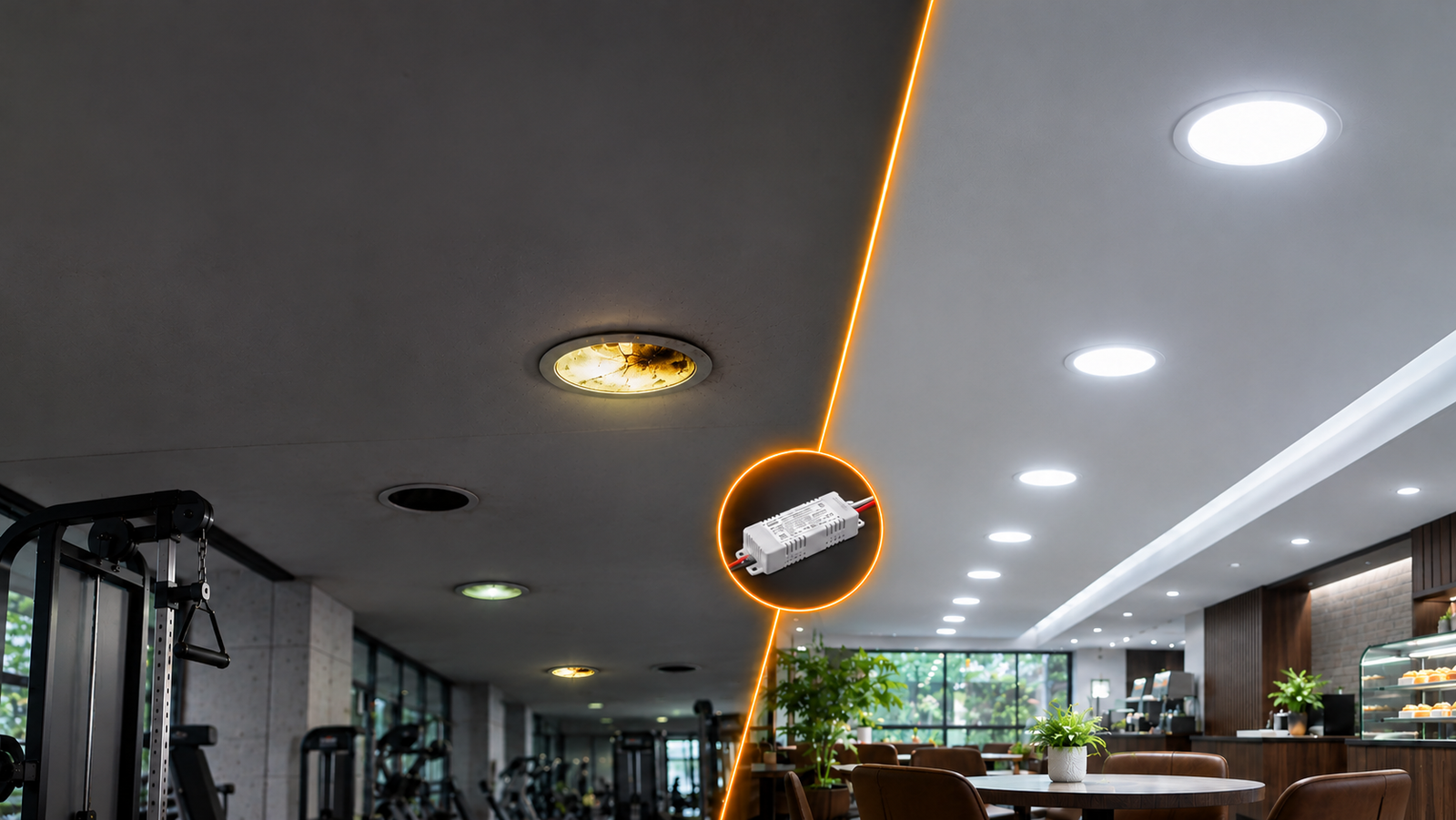

If you are fitting out a gym or a café, cheap LED lighting is hard to ignore. You will probably have three quotes on the table, and one of them will be noticeably lower than the rest. Lighting is a small line next to flooring, equipment and interiors, so the cheap quote feels like the easy place to save.
It rarely is. In commercial spaces that run long hours, cheap LED lighting tends to cost more in the second year than it saved in the first. And the reason is almost never the LED itself. It is something much less visible, sitting above the ceiling: the driver.
The usual pattern: how cheap LED lighting fails
The same sequence plays out again and again in gyms, cafés, showrooms and offices.
- A low-grade driver fails first. LED driver failure is the real culprit, because the LED chips are usually fine. The small box that converts mains power into the steady current the LEDs need is built to a price, and it is the first component to give up.
- LED flicker starts within 12 to 18 months. A few fixtures begin to flicker, buzz, dim or die. In a gym that runs 16 or more hours a day, those months arrive faster than the calendar suggests.
- The whole space gets re-lit. You would think you could simply replace the failed fixtures. In practice you cannot. The original model is often discontinued or changed, the new units do not match the colour of the old ones, and the drivers in the remaining fixtures came from the same batch and are close behind. So you replace everything, and you also pay to remove the old lights.
The saving you made at purchase is spent twice over before the second year ends.
The maths: what cheap LED lighting really costs
Here is an illustrative example for a space with 60 downlights. The prices are placeholders, so swap in your own quotes, but the shape of the result holds.
| Cheapest quote | Quality fixture | |
|---|---|---|
| Fixtures (60 × ₹450 vs 60 × ₹800) | ₹27,000 | ₹48,000 |
| Installation (60 × ₹150) | ₹9,000 | ₹9,000 |
| Year 1 total | ₹36,000 | ₹57,000 |
| Removing failed fixtures, year 2 (60 × ₹50) | ₹3,000 | – |
| Replacement fixtures, year 2 | ₹48,000 | – |
| Re-installation, year 2 | ₹9,000 | – |
| Two-year total | ₹96,000 | ₹57,000 |
The cheap quote saved ₹21,000 in year 1. It then cost ₹60,000 in year 2. Over two years it ended up ₹39,000 more expensive, roughly 68% higher than the quality option.
This table leaves out several things that make the real gap larger: trading hours lost while the ceiling is being re-worked, damage to false-ceiling cut-outs and paint, the customer or member experience while lights flicker, and the higher power bill from a less efficient fixture in the meantime.
What actually drives LED fixture lifespan
A box that says “50,000 hours” is describing the LED chip under laboratory conditions. It is not describing the fixture in your ceiling. A fixture lasts only as long as its weakest part, and these are the parts that decide it.
1. The driver
The driver is the power supply inside the fixture. It is the most common point of failure in cheap LED lighting. Low-cost drivers use lower-rated components, especially electrolytic capacitors, which age quickly under heat. A widely used rule of thumb is that an electrolytic capacitor’s life roughly halves for every 10°C rise in its operating temperature. A driver built with 105°C-rated capacitors from a reputable maker and a sensible design margin will outlast one built to hit a price.
A weak driver also causes flicker. When the driver cannot smooth its output properly, the light pulses at a rate your eye may not consciously see, but your head and your phone camera often do.
2. Heat management
LEDs do not fail from running hot in a dramatic way. They fade faster. Higher junction temperature means quicker lumen depreciation and a shorter life for every component around the chip. Heat sink material, surface area, how the fixture sits in a false ceiling, and the ambient temperature all matter. A thin, light fixture with a tiny heat sink may look the same as a heavier one in a photograph, but it will run hotter for years.
3. The LED chips and how they are binned
Chip quality affects how quickly brightness falls over time. Look for lumen maintenance data (an L70 figure shows the hours until output drops to 70% of the original). Binning matters too. Cheap fixtures often mix chips from different bins, which means slightly different shades of white from one fixture to the next. That is why partial replacement later never looks right.
4. Power quality on site
Voltage swings and surges are routine on many commercial supplies. A driver with a wide input voltage range and proper surge protection survives them. A driver without either takes the damage every time, and it adds up silently over months.
5. Build quality and ingress protection
Housing material, gaskets, wiring and connectors all age. In a gym, sweat, humidity and cleaning sprays are a real factor. In a café, steam and cooking vapour near the kitchen and counter are too. The IP rating needs to suit where the fixture is installed, not just the price tag.
6. Hours of use
A gym lit from early morning to late night puts far more hours on a fixture each year than an office does. Take a typical 16-hour day: 50,000 hours is about 8.5 years of life, but 15,000 hours is under 3 years. Always translate the rated hours into years at your own usage.
Why gyms and cafés punish cheap LED lighting
LED lighting for gyms and cafés works harder than it does in an office. Both run long hours, both often have enclosed ceilings with trapped heat, and both are places where light quality is part of the product. In a gym, flicker affects members training under it and ruins video content. In a café, colour quality shapes how food looks and how long people stay, and every photo that ends up on Instagram carries your lighting with it. Cheap LED lighting that is merely “bright enough” is not enough for either.
How to evaluate an LED lighting quote properly
A quote that only says “12W LED downlight, ₹450” tells you almost nothing. Before you compare prices, ask every supplier the same questions.
- Who makes the driver, and can I see its datasheet? A named brand and model is a good sign. “Standard driver” is not an answer.
- What are the capacitor ratings? Look for 105°C-rated components.
- What are the flicker numbers? Ask for percent flicker or flicker index. Better still, film a sample in slow motion on your phone. Visible banding in the video is a warning.
- What are the power factor and THD? A power factor of 0.9 or above is the usual benchmark for commercial fixtures.
- What input voltage range and surge protection does the driver handle? A wide range with a stated surge rating is what you want.
- Is there a photometric report for the whole luminaire, and lumen maintenance data for the chip? Test reports for the actual fixture matter more than numbers copied from a chip maker’s catalogue.
- What are the CRI and colour consistency? CRI 80 or more is the baseline. Around 90 or more suits food displays and areas where people’s appearance matters. Ask whether the fixtures are held to tight colour binning so that every light in the room matches.
- How is heat handled? Check the heat sink material and weight. Hold a sample in your hand after it has run for a few hours.
- Does the IP rating suit the location? Dry ceilings, washrooms, kitchen zones and outdoor canopies each have different needs.
- What exactly does the warranty cover? Get it in writing. Check the duration, whether it covers the labour and removal costs of a swap or only the part, who handles the claim, and whether the supplier is likely to be around to honour it.
Also check that the product carries the relevant BIS certification, and verify the registration rather than trusting a logo on the box.
A simple sample test
Before you place a full order, ask for two samples. Run them for 24 to 48 hours in a warm, enclosed spot. Then check the housing temperature, film them on your phone for flicker, and compare the colour of the two side by side. This takes an afternoon and costs almost nothing.
Red flags in a cheap LED lighting quote
- No brand or model, only a wattage and a price
- Wattage given but no lumens
- A verbal or one-year warranty
- No datasheet
- No commitment to supply matching units for later repairs or additions
- A price per watt that no one with in-house manufacturing could match without cutting something
Compare cost per year of service, not price per fixture
The useful comparison is not the number at the bottom of the quote. It is this:
Lifetime cost = (fixtures + installation + energy + removal and replacement) ÷ years of reliable service
When you divide the total by the years the lights genuinely work, cheap LED lighting is rarely the cheapest option. The extra spend on a better driver, better heat management and a proper warranty is the cost of buying the lights once.
Frequently asked questions about cheap LED lighting
How long does LED lighting last in a gym?
A well-built LED fixture can be rated for 50,000 hours or more, which is about 8.5 years at 16 hours a day. In practice, life depends on the driver and on heat. Cheap LED lighting with a weak driver can start failing within 12 to 18 months.
Why do LED lights flicker after a year?
The most common cause is a failing driver. Ageing capacitors can no longer smooth the current, so the light pulses. Heat and voltage surges speed this up.
Is cheap LED lighting worth it for a café?
Rarely, if the café runs long hours. The upfront saving is small next to the cost of removing and replacing the whole installation, as the worked example above shows.
What CRI should café lighting have?
CRI 80 is the baseline. Aim for CRI 90 or higher over food displays, counters and seating where people look at their plates and at each other.
The bottom line on cheap LED lighting
The cheapest quote is not the one with the lowest price. It is the one you only have to pay for once.
Noble Electricals has been designing and manufacturing commercial LED lighting in India since 1979, and our fixtures have lit gyms, hotels, offices and bank branches across the country. If you are comparing cheap LED lighting quotes for a gym, café or any commercial space, send us the one you have. We will go through it line by line, covering the driver, thermal design and warranty, and tell you plainly where it is strong and where it is likely to become a year-2 problem.
Explore our work at noblelights.in.
This is really helpful, I was planning for my interior including lighting and this gave me a point to improve the quality of lighting